Tuesday, 26 June 2012

'Boring' Spain march on

Spain face Portugal in the first semi-final of Euro 2012 and the build-up has been reduced to whether Ronaldo can beat Spain single handedly and whether Spain would change their approach after being labelled 'boring'.

Both statements are founded in ridiculous hyperbole and have reduced the amount of interesting journalism undertaken in the (English) mainstream press. CR7 has had quite a good tournament; scoring in five successive tournaments for Portugal isn't bad, but to suggest that the rest of the Portugal side are a side show waiting for Ronaldo to rescue them is to ignore the depth of experience in the side.

Other than Miguel Veloso, the indifferent Raul Merieles and the absence of a out-and-out striker, Portugal have one of the form teams in the tournament and they have an enormous amount of continental experience. Pepe and Bruno Alves have looked imperious at the back, while the two full-backs are amongst the most dangerous in Europe. Joao Moutinho has been superb and with two seasons under his belt at Porto looks like fulfilling his early promise. Nani came to Poland and Ukraine on the back of a poor league season but has impressed thus far.

Ronaldo has found some form at Euro 2012, taking 30 shots will help, but to suggest that Portugal are a weak team without him is foolish. The have shown enough to indicate that they will give Spain their toughest test at Euro 2012 and the Portuguese looked close to matching Germany, despite showing them too much respect in the 1-0 defeat.

After posting eight goals in their first four games, only behind Germany with nine, people seem to have got it in for Spain and the 'boring' tika-taka football that they've produced this tournament. After conceding just one goal in games against Italy, Croatia and France the Spanish squad have genuinely had to answer questions about their playing style and whether they would change it.

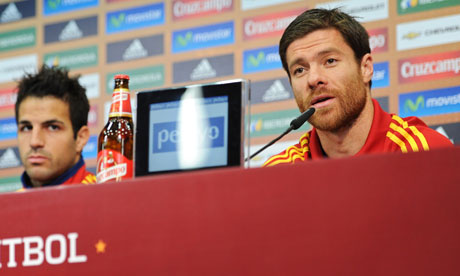
That the whole world was fawning over tika-tak football two (and four) years ago has been conveniently forgotten, and Xabi Alonso and Andreas Iniesta have had to declare in press-conferences that Spain would be sticking to their principles and passing philosophy.

Guillem Balague alluded to the extraordinary scrutiny and pressure that Spain are under and it seems to be fashionable to pick holes in the Spanish at present. The Chelsea Champions League win falsely reinforced a notion that playing ultra defensively will regularly defeat a passing machine and this has contributed to a footballing culture more happy to critique possession football.

Chelsea's win was down to some extraordinary luck in at least three of their European ties and was supposed to be based on the model that Inter perfected in 2010. The main difference being that Inter produced a masterclass in defending, so good it is unlikely to be matched, whereas Chelsea rode their luck and thumped it up to man-mountain Drogba. To defend that well, to a man, and eliminate Barcelona will happen 1 in 10 matches and Inter also rode their luck regarding Bojan's legitimate goal.

To contend that Spain need to change their approach is an absurd statement and from where I'm sitting their football this tournament has been superb. I can count two clear chances that they have conceded in four whole matches; the Di Natale goal and Rakitic chance v Croatia. Both were created on the counter and required two pieces of excellent individual skill, a step over and perfect pass from Pirlo and a mazy run and outside of the boot cross from Modric to come close to breaking Spain down.

As part of tika-taka football Spain will monopolise the ball and unless they come up against a foolhardy side, they will have to break down three walls of opposition players, quite a challenge. By keeping the ball for longer and playing less openly Spain are protecting Sergio Ramos and Gerrard Pique, which is a raw partnership and less stable than a Pique and Puyol or Puyol and Marchena.

The Spanish have now gone eight knock-out games without conceding a goal, which is normally a great way of progressing at competitions. Spain are not here to play entertaining football and put on a show for the public. They come to Poland and Ukraine looking to be the first side to win three successive tournaments and based on their form and resilient displays so far, look favourites to do that.

Monday, 25 June 2012

England once again find their level


England were left to rue their inaccuracy on penalties as they suffered a 4-2 penalty defeat to Italy after 120 goalless minutes in Kiev. Statistics never tell the full story but with a possession of 34%, joint with the damage Greece inflicted on Germany, and an average of 2.75 shots on target a game it is easy to see why England failed to trouble many teams.

That it took a penalty shoot-out to finally finish England off was indicative of some profligate finishing from Italy and the dogged determination of the England players. Sadly this seems the only trait that English players can excel at in international competition, and bravery and commitment are no longer enough to win a major tournament.

Roy Hodgson has come in and in the space of just ten training sessions done all that he can; make England harder to beat. Hodgson can do little about the scarcity of players brave enough to demand possession of the ball and was denied the presence of one who can, Jack Wilshire, through injury. But to suggest that Wilshire in midfield would have seen us dominating other teams in possession stakes is wildly optimistic and glosses over the deeper issues at hand.

The £750 million invested on Wembley Stadium still has a long way to go before it repays its outlay and the FA must be wishing that more of that money was invested in youth coaching. Other than Jack Wilshire there is a dearth of ball friendly midfielders in England set-ups and the FA are now several years behind other nations in their development programmes.

Germany completely overhauled their youth development eight years ago under Jurgen Klinsmann and Joachim Low, with the tacit approval of the Bundesliga, and their crop of midfielders at Euro 2012 reflects their philosophy. Until the Premier League agrees to a reduction of power and influence in England the FA and national set-up will continue to struggle. There needs to be a readdress towards the FA and the national side, but with the rampant financial success of the Premier League this looks increasingly unlikely.

England could quite easily have lost all four of their games at Euro 2012 and only dictated the majority of the play in one of them, against Sweden. There was no goal-line injustice or red card to rage against or hide behind this tournament. England were given a football lesson by the Italians and a revaluation of how England approach football will need to start soon. Past tournaments have provided the nation with a scapegoat or a reason to put off any major change. England’s meek exit this year may finally see an overhaul of a nation still clinging to 1966 as they finally move on. 

Monday, 4 June 2012

European team of the year 2011-2012

Goalkeeper: Joe Hart

With a second year as no. 1 at Manchester City under his belt, Hart is fast becoming one of the best stoppers in the world and remains England's only world-class player. Conceding just 29 goals in the Premier League helped City to the title this year and Hart has made some stand-out stops in their campaign; an instinctive save to deny Darren Bent the pick of the bunch, earning all three points for his side in the process.  Although he has had the leagues best centre-back pairing in front of him, Hart has had to produce when it counted and he duly delivered.  Special mentions go out to David De Gea who recovered from a shakey start at United and had the best shot to save ratio in the league and also to Italian stalwart Gianluigi Buffon, who had another superb season.

Right back: Lukasz Piszczek

The Borrusia Dortmund full-back had a second excellent season in Germany, a season which culminated in a second successive league title for Jurgen Klopp's young side. The Polish full-back was actually a free transfer from Hertha Berlin in 2010 and in those two years the former midfielder has transformed into one of the most dynamic right-backs in the game. He marked Frank Ribery out of the DFB Cup final which Dortmund won 5-2 and still managed to maintain an attacking threat. Real Madrid are rumoured to be hovering and if Poland have a strong Euro 2012 expect other teams to join them.

Left back: Ashley Cole

Despite a fairly poor start to the season, 'Cashley' has turned it on when the performances have really counted. Since the departure of AVB, Cole has put in a series of world-class shifts for Chelsea and was instrumental in their Champions League win. His goal-line clearance in Naples prevented Napoli taking a 4-1 lead to Stamford Bridge and surely kept Chelsea in Europe. Compettion in the full-back positions was pretty sparse this season; Phillip Lahm was solid if unspectacular and Giorgio Chiellini impressed when shunted out to the left, but Cole was the player who delivered in the big games.

Centre backs: Vincent Kompany and Mapou Yanga-Mbiwa

Vincent Kompany was finally handed the captains arm-band after Mancini stopped pandering to Carlos Tevez and the Belgian has been the best centre-back in Europe this season. As anyone who plays Football Manager will testify his £6 million fee was a superb transfer and after muddling around in midfield under Mark Hughes he was finally placed in the centre of the Man City defence. He marshalled the meanest back-line in the Premier League this season and unlike the place of Vidic at United, his presence in defence was essential for City; without Kompant they fell apart, but the skipper returned in time to halt the slide and scored the deciding goal in the Manchester derby.

There were several contendors to play alongside Kompany but the 23-year-old captain of Montpellier wins the spot. Mbiwa led his side to an incredible success in Ligue 1 and was extremely unfortunate to not make  Laurent Blanc's 23 man squad for the Euro's, losing out to Laurent Koscielny who was part of that impervious Arsenal defence. Mbiwa has been at Montpellier for over six years and has already amassed 165 games for them. Montpellier were outscored by the Qatari funded PSG, but conceded just 20 goals in a defence that was superbly marshalled by Mbiwa. Matt Hummels of Dortmund came close to making the team, as did Sergio Ramos who I must begrudgingly admit had an excellent season at Madrid, when  not falling out with Mourinho.

Defensive midfield: Andrea Pirlo

There have been some inspired free transfers this season; Demba Ba to Newcastle, Brad Friedel to Spurs, Phillip Mexes to AC Milan but the move of Andrea Pirlo from Milan to Juventus will come back to haunt Milan for years to come. Milan are renowned for having an ageing midfield but after allowing World Cup winner Pirlo to leave on a free he was snapped up by Juventus who proceeded to win the league without defeat. In Antonio Conte's system, Pirlo has been dropping even deeper than before, and with Arturo Vidal and Antonio Marchisio pressing the opposition high up the pitch, he has been presented with the time and space to dismantle opposition defences. Juventus tightened up their defence to win this years Scudetto and the arrival of Pirlo helped them dictate play and ultimately win the league.

Centre midfielders: Yaya Toure and Mezut Ozil

Yaya Toure returned from the African Cup of Nations just in time to help City to their first title in 41 years, and if the Ivorian had been missing for one or two more games the title might have been  out of reach. The younger of the Toure's carried City through games early in the season and his dynamic runs from midfield would often create a goal from absolutely nothing. Upon his arrival pundits were quick to pigeon-hole the Ivorian as a holding midfielder and expressed surprise when he broke from deep to such devastating effect. The English media have finally caught up with what Yaya Toure can bring to a team but not before he lifted Man City to the title.

After doing well in his first year in Spain, Mesut Ozil has taken his game even further this season and was one of the reasons behind Madrid outscoring Barcelona to la Liga. Ronaldo might have grabbed the headlines with his goal tally, but the diminutive German finished with a remarkable 17 assists in his 35 league games, including that assist in the decisive el Classico for Ronaldo's winning goal. Ozil is keeping former World Player of the Year, Kaka, out of the Real Madrid team and he is central to their chances of repeating their success again.

Left wing: Cristiano Ronaldo

Despite scoring 60 goals in 55 appearances I've had to shift Real Madrid's main man out to the left hand side of attack. Say what you like about the competitiveness of the Spanish league, Ronaldo has blitzed opposition defences this campaign and is unlucky not to be selected up front in this team. Pretty self explanatory.

Right wing: Lionel Messi

Not being Pep Guardiola, I couldn't find room in my 4-3-3 formation for a false number 9 role for Messi, so unfortuantely the two best players in the world are out wide. Although I'm pretty confident he could do some damage from out here.


Striker: Radamel Falcao

Competition for this position was especially fierce. Robin Van Persie has had a sublime season as has compatriot Klass Huntelaar, both hitting more than 40 goals. Oliver Giroud of Montpellier also had an excellent season, hitting 25 as his side won the French league, while Sergio Aguero looked as if he had been playing Premier League football his entire life.

But for me one striker stood out and I would be amazed if Falcao is still at Atletico Madrid next season. The 26-year-old has every facet to his game. He is powerful, fast, strong in the air, can score golazo's and is a big game player. After deciding the 2011 Europa League final with a brave header for Porto, the Columbian tore apart Bilbao in this years final scoring twice with two equally brilliant goals. To have the presence of mind and ability to execute a Cruyff turn on the six yard box, take three defenders out of the game and then finish is staggering. He scored 36 goals in what was his first experience of Spanish football and will have Europe's elite chasing his signature this summer.


Sunday, 20 May 2012

Glory for Chelsea, defeat for purists

Chelsea finally proved that money can buy you everything as they claimed their first ever Champions League after beating Bayern Munich 4-3 on penalties.

Roman Abramovich's dream of a European triumph was realised after a 9 year quest, and one of the Russian's first signings , Didier Drogba, made the difference.

At a time when Andy Carroll fetched £35 million, the £24 million to Marseille looks a snip considering his eight years of service. Say what you like about the Ivorian's theatrics, he has decimated the continent this season and has been the best striker in the PL for the last five years.

Chelsea needed their striker to be in superb form as they were on the backseat for the majority of yesterdays final. Their win was also down to no small portion of luck; the Germans created enough chances to win, as did Barcelona and Napoli in the previous rounds.

After some woeful performances under AVB, the foursome of Ashley Cole, Petr Cech, David Luiz and Gary Cahill were all magnificent in Bavaria, as they have been since the exit of the Portuguese manager.

That it took the exit of one of Europes finest young coaches to kickstart their season is troubling, but under Bobby Matteo Chelsea have gone back to basics, and in Europe this proved to be the difference.

Abramovich reportedly has a grand vision of Chelsea playing as 'Barcelona in blue shirts' but yesterdays win was more reminiscent of Stoke in blue shirts, as Chelsea defended for the whole match before scoring with their first corner.

Of course a team of Bayern's stature should be able to defend a set-piece, but Chelsea played to their strengths and it proved effective. AVB tried to change Chelsea's reliance on the direct ball to Drogba and ultimately lost out.

Chelsea clearly rode their luck in Europe. If Barcelona or even Napoli had been less profligate they would have eliminated the blues and Chelsea didn't exactly read the textbook on defending your way to victory.

Mourinho's Inter Milan showed several defensive masterclasses en route to their 2010 win, and with a midfielder of Wesley Sneijder's guile were always a threat, a 3-1 over Barca indicative if their abilities. By contrast, Chelsea showed vulnerability. They gave away two needless penalties (both saved) and it really did seem as if fate would fall their way.

Worse squads have won the Champions League, but the plucky fight of this Chelsea this campaign is remarkable. Despite being outplayed in several games, Di Matteo's side simply took their chances and after eight years practise they finally held their nerve.

Sunday, 6 May 2012

Two hands on the title?


Sir Alex Ferguson conceded that Manchester City had two hands on their first Premier League title yesterday after the Citizens overcame a battling Newcastle side 2-0 on Sunday.

Barring a slip-up against lowly QPR, or a ridiculous goal-swing, Roberto Mancini looks to be on his way to his fourth league title, and his first in England. City deserved the win over Newcastle, but it was their manager who deserves most of the credit for his game-changing substitution in the 61st minute.

Replacing the, again ineffective Samir Nasri, for the on-paper more defensive midfield bruiser, Nigel de Jong, Mancini relieved some of the defensive duties on Yaya Toure and within 10 minutes the Ivorian went on to score the all important first goal.

At the time of Mancini's substitution I imagine City fans up and down the country were cursing their Italian and obviously defensive manager in a game that they needed to win, but the tactical switch proved to be telling and looks to have wrapped up the title for City.

Mancini was heavily criticised in his first year and a half in Manchester for being too cautious and was superbly vindicated by his substitutions and tactics today. A dangerous Newcastle side were well contained and Manchester City's cosmopolitan squad showed no sign of choking in this match.

With a five point lead over Mancini and his team, Ferguson had United in prime position a month ago. The defensive mistakes that have blighted the last few United performances can be accused, but the anaemic side that Ferguson put out in last weeks derby was a real turning point and a huge tactical error from the Scot.

Ferguson has had success hitting teams on the counter in the past, notably against Arsenal with Ronaldo running riot, however in the 'unmissable' game last week the United midfield were almost embarrassed by Man City's midfield engine.

A midfield of Scholes, Giggs, Carrick, Park and to a lesser extent Nani, has no dynamism to it and Manchester City were able to press incredibly high-up the pitch, much like Barcelona. Sir Alex got his tactics spectacularly wrong that night, in trying to match City up on the pitch and in effect try to take the draw, he played straight onto the hands of Mancini.

Player-to-player you would argue that City are by far stronger than the individuals in the United team. Aguero and Tevez are much better than Rooney and Welbeck, Hart beats De Gea, Kompany and Lescott are the best defensive pairing in the league, whilst Silva and Toure have carried City through several games this year. What has cost City at stages this season is their inability to always perform to their maximum potential, whereas United tend to over perform in more matches.

Rather than stick to their attacking flair, provided by the outstanding Valencia and Young, Ferguson tried to shut up shop and contain the most potent attacking side in the league. It went badly wrong and the tactical gamble looks like costing United the league.

Meanwhile, in the Budweiser Cup there was a rather predictable result as Chelsea just about did enough to beat a poor Liverpool side. Chelsea bossed the game for 60 minutes and it took the introduction of Andy Carroll to stir Liverpool into some response.

Carroll looked as if he had entered a time-warp and was reminiscent of the player that terrorised defences during his time at Newcastle. He gave John Terry a torrid time and somehow managed to dance round the former Engalnd skipper to score for Liverpool.

He was unlucky not to equalise, after Petr Cech pulled off a superb save to deny him his second, though you could argue the striker ought to have scored, heading it into the ground would have given Cech no chance. I would take Carroll to the Euro's and his third goal in four Wembley appearances may just have done enough for the Geordie.

Peter Crouch was propelled to the top of the England strikers queue after scoring a worldie and then doing little else, but for me Carroll can alter a game more dramatically and is most definitely one for the future.

Deplorable as he is, Ashley Cole was magnificent on Saturday and the left-back now has seven FA Cup winners medals. His form this season has been patchy, but since seeing Leighton Baines take his traditional place in the PFA team of the year, Cole has turned in superb performances both domestically and in Europe.

As for King Kenny, he is in for an arduous summer. Liverpool needed the FA Cup to avoid their season being branded a failure and are still £100 million worth of investment away from challenging the top four.

The Liverpool midfield is woefully ill equipped and Steven Gerrard was culpable on Saturday evening. Spearing and Henderson were the sitting midfielders, but after proving inefficient, Gerrard kept dropping back to just in front of his defence to pick up the ball and as a result the Liverpool midfield has well out of shape.

Liverpool have not replaced Mascherano and Alonso and with Gerrard on the wane for the last two seasons, they may be looking at three new midfielders before they can start competing again.

Wednesday, 2 May 2012

Remember Demba Ba?


Deconstruction of the 'people's choice'


England ended months of doubt on Monday as Roy Hodgson was confirmed as the new England manager on a four year deal. 

Instead of backing England's new man, the mainstream media seem to have developed a complex because Hodgson is not Harry Redknapp, dubbed the 'people’s choice'.

When Capello departed, in early February, Redknapp was immediately assigned the role as favourite to replace the Italian, despite little evidence to support his elevation. Redknapp was cleared of tax evasion on the same day as Capello's exit, which sparked debate that these things were 'meant to be'. Now Redknapp was out of court the England job was his to stroll into. 

A comparison of the respective managerial records of the two men is telling:

Redknapp – Won: 518, Drawn: 317, lost: 437, Win percentage: 40.76. League titles: 0, FA Cup Wins: 1, CL Quarter Finals: 1, Premier League Manager of the Year 2009/10
Hodgson – Won: 408, Drawn: 283, lost: 257, Win percentage: 43.04. League titles: 5, Europa League Finals: 1, UEFA Cup Finals: 1, LMA Manager of the Year 2010


The 64-year-old Hodgson has been managing since retiring at 28 and his coaching experience has taken him off to Scandinavia, Internazionale, the Premier League, Finland, the UAE before returning to the Premier League, succeeding at Fulham and West Brom.
Redknapp might boast an FA Cup win with Portsmouth in 2008, but in total the former West Ham player totals more relegations than promotions. The FA Cup victory with Portsmouth is an inflated prize; in winning in 2008 Redknapp spent way above the typical means at Portsmouth and the club entered administration two years later.
The 65-year-old is not solely to blame, but the signing of John Utaka on £50,000 a week was disastrous, with the Nigerian pace-merchant only leaving in January 2011 after scoring 10 in 90.
Both men have almost three decades of managerial experience and are only just gaining wider recognition. Redknapp worked the lower football leagues for years, while Roy learnt his trade in Sweden winning several titles.

In terms of recent success the obvious comparison is Redknapp making it to the last eight of the Champions League with Spurs or Hodgson reaching the Europa League final with Fulham.
Both were impressive, but for a squad of Fulham’s stature and lack of substantial investment, to go all the way to the final in 2009 is an incredible achievement, surpassing getting a very good squad of players to the Champions League quarters.
Hodgson also boast more than 80 games at international level. He guided the Swiss to third place in FIFA’s world rankings in 1994 and came three points from taking Finland to their first ever major competition in 2008.
He was head-hunted to be a UEFA’s chief scout in 1996, and in this role produces dossiers on all the major club sides and national associations in European football, experience that could prove vital this summer.
Compare this with Harry Redknapp’s continental experience and all the media favourite can point to is one game in Europe with Portsmouth and one season in the Champions League with Spurs.
To compare the two is a complete mis-match and begs the question, why was Redknapp so widely tipped as favourite for the head role? What does Redknapp count as an advantage over Hodgson? What evidence is there to confer Redknapp as the 'people's choice'?
The lack of evidence to advance Redknapp as an international manager was glossed over by journalists and former players over the last few weeks, with most resorting to that assertion that Redknapp is a good man-manager.
That these qualities were even deemed important for the next England manager suggests why England are almost decades behind teams on the continent and in the Americas.
Hodgson completely surpasses Redknapp technically; his training drills are infamous for their complexity and duration. By contrast, Redknapp leaves training exercises to a coaching team of Joe Jordan and Kevin Bond and once famously told new-signing Roman Pavlyuchenko to “run around”.
Despite these deficiencies Redknapp was dubbed the ‘people’s favourite’ by the majority of the media and their indignation at being proved wrong by the FA exploded on Monday as Hodgson was finally confirmed.
I could find only one journalist who had positive thoughts on Hodgson’s appointment, from the Telegraph’s Henry Winter, with the rest keen to express outrage that their pal Redknapp was impossibly overlooked.
Redknapp has a reputation for being a good talker, his press conferences and Range Rover interviews would always provide journalists with a ready-made sound bite. He clearly had a closer relationship with the media than Hodgson who only has six years’ experience as a manager in England.
Hodgson has had to endure a torrent of negative articles about his style of play, his lack of man-management (despite none of these people having worked under him) and the pieces conclude with his disappointing six months in charge at Liverpool.
To condemn a man’s entire career based on one six month spell is at best simplistic and at worst a falsehood. Hodgson has tremendous experience and prestige around the footballing world, which is not replicated among the British press

The assumption that Harry Redknapp could come in and make the same old group of players start knocking it about like Real Madrid is a wild presumption. Tottenham played good football this season because of the players they have, not because of Redknapp. 
From a completely rational decision process it is clear that England under Hodgson would be the greatest fit. Hodgson has international experience, gets the best out of his players, is tactically astute and is a great choice to develop the St George's Park project. Redknapp is clearly a good manager, but his acclamation as the 'people's choice' was unwarranted and is to gloss over the superior candidate; one who has won over the Football Association, if not the media.